Software as Seva
Human values · Thoughtful systems · Code with compassion
Technology shapes the rhythm of modern life. It influences how we communicate, organize, remember, learn, and serve. At Software Seva, we believe software should support human clarity and freedom rather than compete for attention or create dependency.
We build systems with a simple intention: technology should help people do meaningful work with greater ease, dignity, and calmness.
Software should not become another source of noise. It should quietly support what matters.
What does Seva mean in technology?
Seva is often understood as selfless service. In the context of technology, it means building with responsibility, restraint, and care for the human beings who will ultimately live inside the systems we create. Every technical decision carries consequences for:
- what we optimize for
- what we measure
- what we interrupt
- what we store
- what we encourage
- what we quietly normalize
Software is never completely neutral.
At Software Seva, we try to approach engineering as a form of thoughtful service. We value simplicity over unnecessary complexity, clarity over noise, and long-term usefulness over short-term engagement.
The best technology often becomes almost invisible. It allows people to focus on learning, teaching, organizing, creating, serving, and living more fully.
That is the kind of software we aspire to build — not software that captures attention endlessly, but software that supports human flourishing and then quietly steps aside.
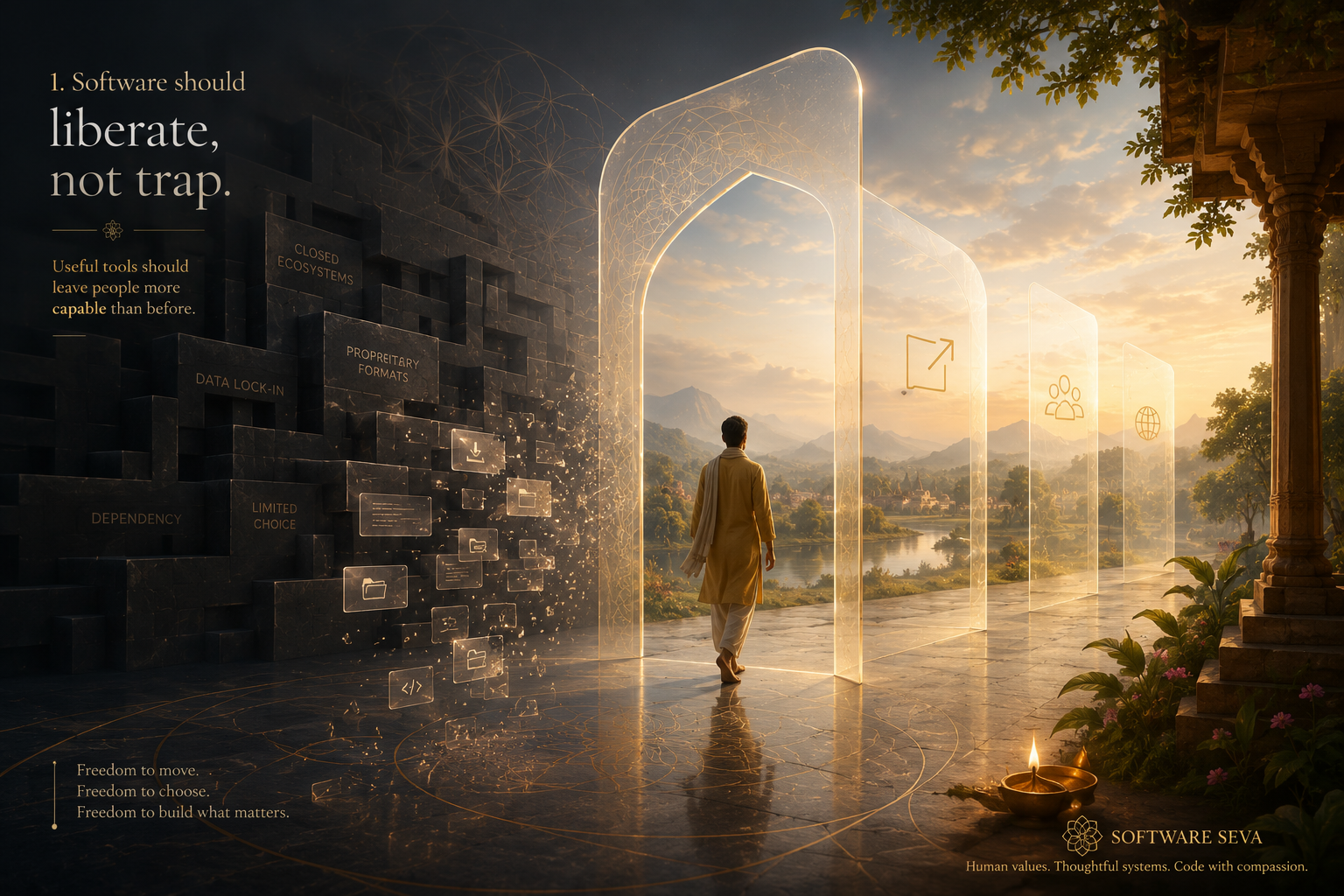
Software should liberate, not trap
Useful tools should leave people more capable than before
Many modern platforms are designed to create dependency. They lock users into closed ecosystems, discourage portability, and slowly turn simple tools into permanent subscriptions to complexity.
We believe software should do the opposite.
A good system should increase freedom. People should be able to move their data, understand their workflows, and continue their work even if the platform changes tomorrow. Technology should help communities become more resilient and self-reliant, not more dependent on distant systems they cannot control.
Software should feel like a well-made tool: dependable, understandable, and respectful of the person using it.
We prefer open standards where possible, lightweight architectures, graceful degradation, and systems that continue functioning even when networks fail or infrastructure becomes unreliable.
The goal is not to trap users inside software. The goal is to help them accomplish meaningful work and move forward with greater clarity.
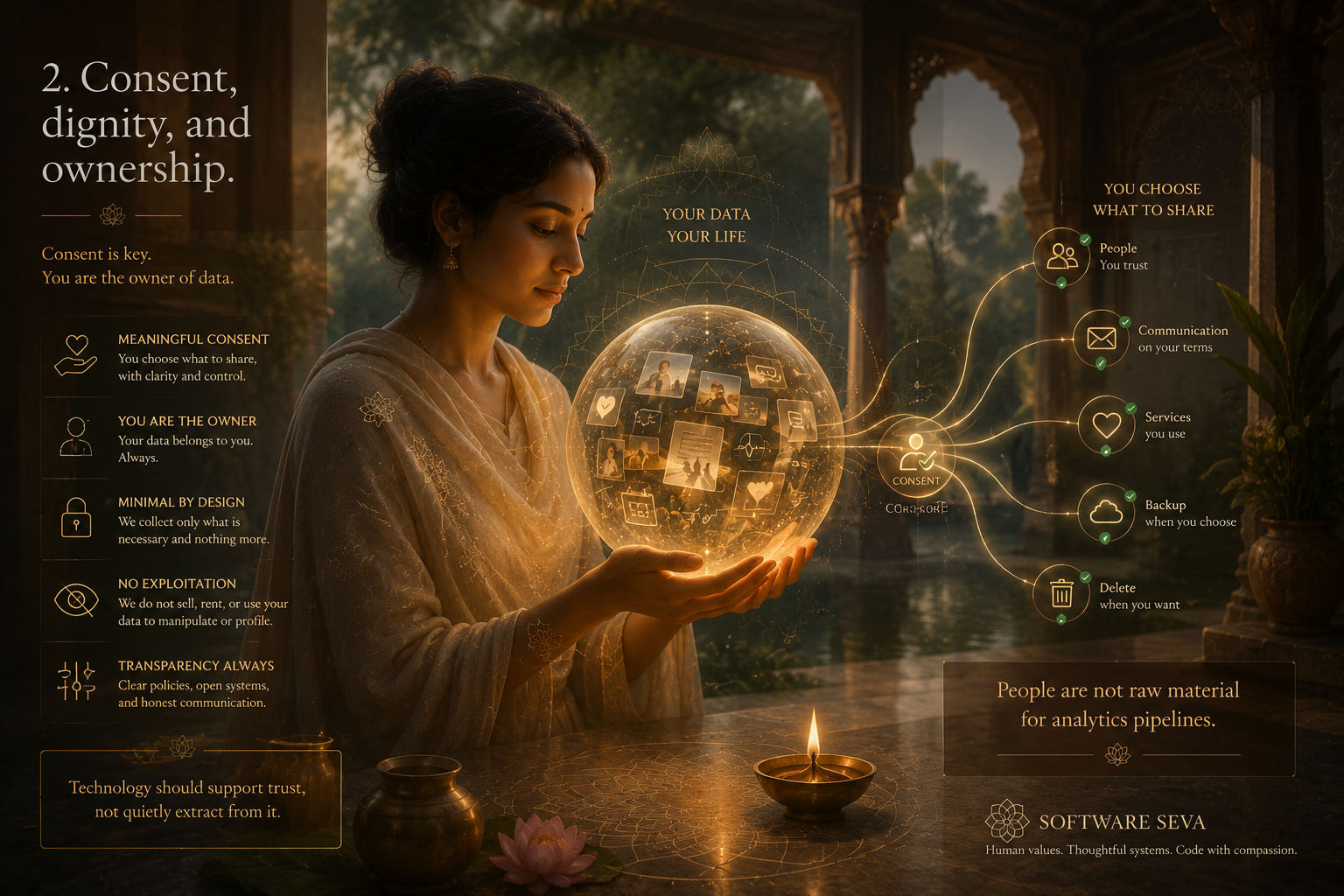
Consent, dignity, and ownership
Your data belongs to your life, not to engagement pipelines
Privacy is not merely a compliance requirement or a legal checkbox. It is connected to dignity, trust, and autonomy.
People should know what information is being collected, why it is being collected, and how it is being used. Consent should be meaningful, understandable, and reversible. Users should not be forced into surveillance in exchange for convenience.
At Software Seva, we believe people remain the owners of their data. Systems should collect the minimum necessary information, store it responsibly, and avoid unnecessary centralization whenever possible.
We do not believe human lives should become raw material for engagement metrics, advertising pipelines, or behavioral manipulation.
Technology should support trust, not quietly extract from it.
This philosophy shapes the way we approach authentication, storage, analytics, communication systems, and user workflows across every project we build.
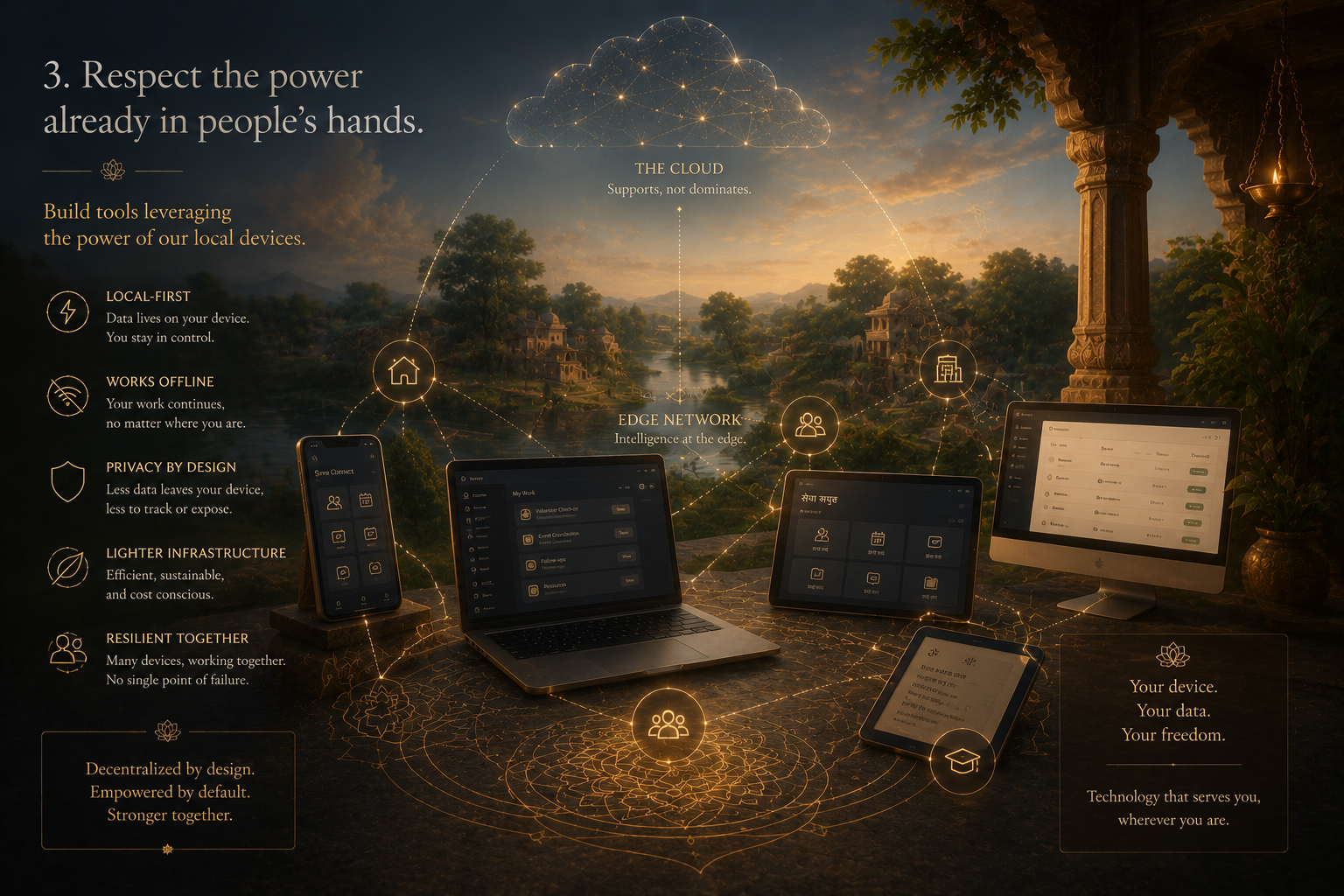
Respect the power in people's hands
Build with the device, not only the cloud
Modern devices are extraordinarily capable. Phones, tablets, and laptops now possess computing power that was once available only to large organizations. Yet many systems continue to depend entirely on centralized infrastructure for even the simplest tasks.
We believe software should make better use of the power already present in people’s hands.
Whenever practical, systems should work locally, continue functioning offline, and reduce unnecessary dependence on remote servers. Local-first and static-first architectures often create experiences that are faster, calmer, more resilient, and more privacy-conscious.
This approach is not only technical. It is philosophical.
When software continues working without constant connectivity, people feel more in control. Their tools begin to feel less like rented services and more like instruments they genuinely own and understand.
Cloud infrastructure still has an important role. But it should support human work thoughtfully rather than absorbing every interaction into centralized systems by default.
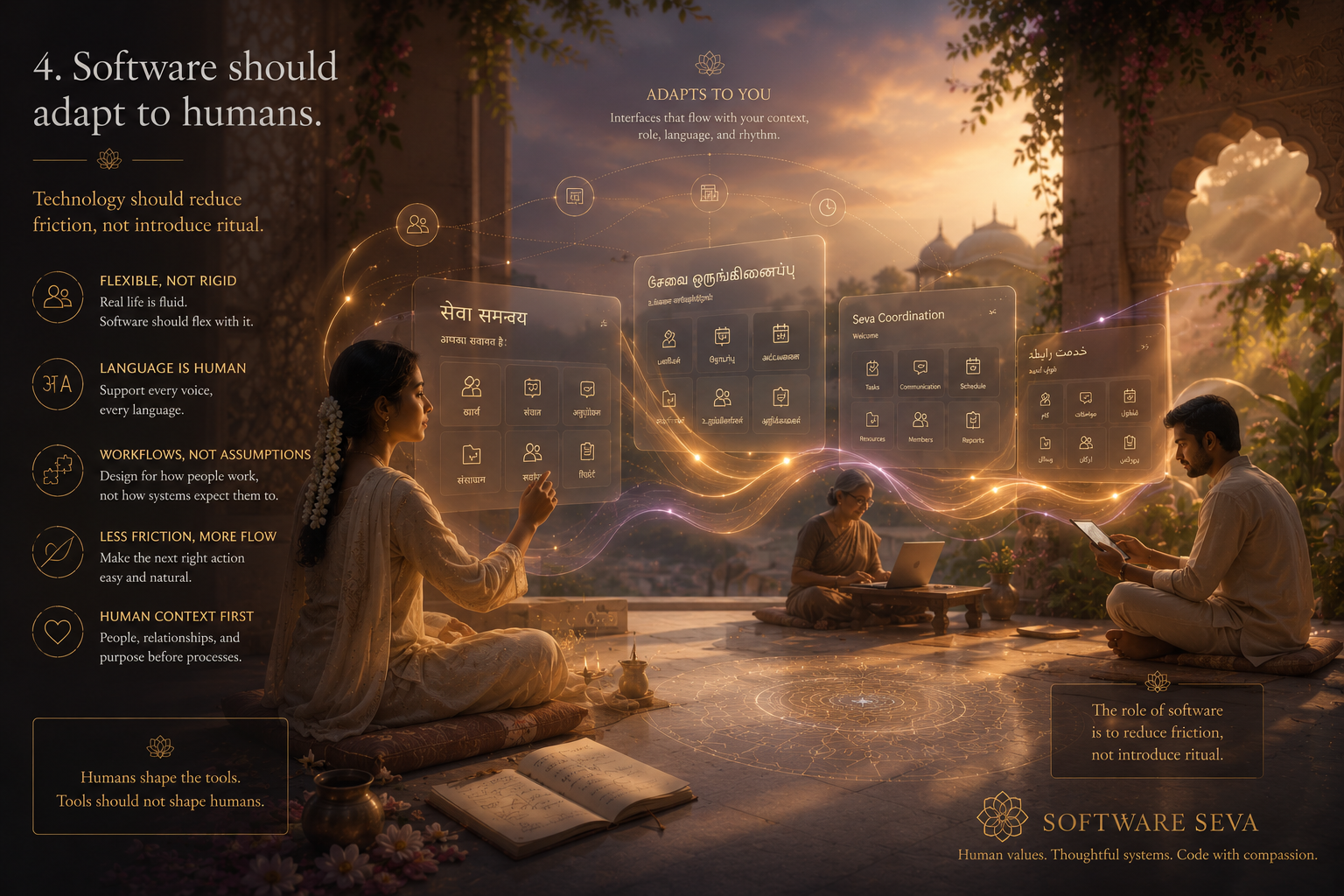
Software should adapt to humans
Technology should reduce friction, not introduce ritual
Too often, people are forced to change their natural way of working simply to satisfy the assumptions built into software.
Real communities are dynamic. Languages overlap. Processes evolve. Volunteers improvise. Teachers adapt. Families coordinate differently. Human work rarely fits perfectly into rigid abstractions.
We believe software should meet people where they are.
Good systems reduce friction instead of introducing bureaucracy. They help people continue their work with greater ease rather than forcing them to think like databases, spreadsheets, or workflow diagrams.
This is especially important in community-oriented work where relationships, continuity, and trust matter more than optimization metrics.
At Software Seva, we try to build flexible, multilingual, human-centered systems that support real-world workflows instead of replacing them with unnecessarily rigid processes.
Technology should assist human intelligence, not compete with it.